

Written By : Andhra University Online Editorial Team


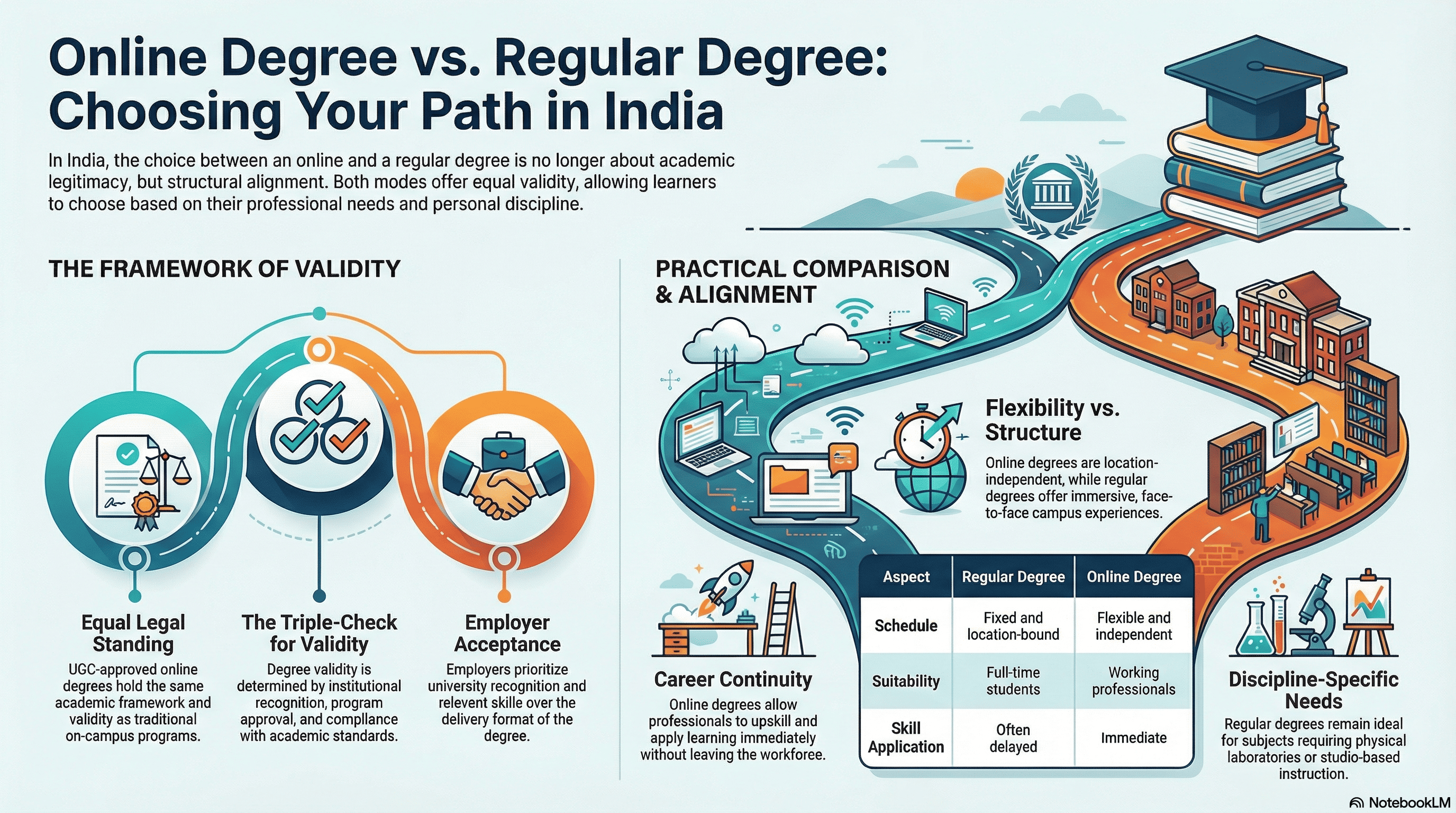
Introduction — Online Degree vs Regular Degree: A Strategic Choice
The question of online degree vs regular degree is no longer academic. It now affects career mobility, eligibility, lifelong learning, and access to education itself. As higher education expands beyond physical campuses, learners are no longer choosing only what to study, but how learning fits into their professional and personal lives.
This comparison is often framed emotionally—online versus classroom, flexibility versus discipline. In reality, the difference is more structural and regulatory than ideological.
Key takeaway: The real question is not which mode is superior, but which mode aligns better with how careers and learning now function.
Table of Contents
What defines a regular degree and an online degree?
A regular degree is delivered through on-campus, face-to-face instruction, with fixed schedules and physical presence as a core requirement. A UGC approved online degree, on the other hand, is delivered digitally but follows the same academic framework, evaluation standards, and degree-awarding authority as traditional programs—provided it complies with regulatory norms.
The distinction lies in delivery, not in the academic intent of the qualification.
How does degree validity work in India?
Degree validity in India is determined by:
- Recognition of the awarding institution
- Approval of the program by the regulator
- Compliance with prescribed academic standards
This applies equally to regular and online programs. Concerns around online degree validity in India largely stem from the period when online education lacked clear regulation. With formal UGC frameworks now in place, validity is no longer defined by mode alone.
Online Degree vs Regular Degree: A Practical Comparison
| Aspect | Regular Degree | Online Degree |
|---|---|---|
| Mode of Learning | On-campus, in-person | Fully online |
| Degree Validity | Valid if the university is recognised | Valid if UGC approved |
| Academic Authority | University | University |
| Schedule | Fixed, location-bound | Flexible, location-independent |
| Access | Limited by geography | Accessible nationwide |
| Suitability for Working Professionals | Limited | High |
| Skill Application | Often delayed | Can be immediate |
| Career Alignment | Linear | Continuous and adaptive |
Key takeaway: Online degrees reduce access barriers without altering academic legitimacy.
Where regular degrees still hold strength?
Regular degrees remain valuable for learners who benefit from structured environments, physical peer interaction, and immersive campus experiences. Certain disciplines that rely heavily on in-person laboratories or studio-based learning may still prefer on-campus formats.
However, these strengths are contextual—not universal.
Why online degrees increasingly align with modern careers?
Careers today are non-linear. Professionals upskill, reskill, and shift roles without stepping out of the workforce. Andhra University Online Degree aligns naturally with this reality by allowing learning to occur alongside employment, entrepreneurship, or family responsibilities.
They also support:
- Continuous professional development
- Immediate application of learning
- Broader access to higher education
This is why the question Which is better: an online degree or a regular degree? increasingly depends on career stage, not academic hierarchy.
Key takeaway: Online learning does require self-discipline, time management, and digital comfort. The absence of a physical campus can reduce informal peer interaction for some learners. These are not academic disadvantages, but learning-style considerations.
Conclusion
The debate between online and regular degrees is no longer about legitimacy; it is about alignment with how education and careers now evolve. Regular degrees continue to serve learners who thrive in structured, campus-based environments, but online degrees have emerged as a powerful, equally valid alternative—especially for those navigating work, career transitions, or geographic constraints.
With clear regulatory oversight and UGC approval, online degrees now offer academic credibility alongside flexibility, making them increasingly relevant in a workforce that values adaptability, continuous learning, and practical skill application over physical attendance alone.
Frequently Asked Questions (FAQs)
Yes, when the online degree is offered by a recognised university and approved by the University Grants Commission under its online education regulations.
Yes. Employers typically evaluate the university's recognition and the relevance of skills, not the delivery format, especially for UGC-approved online degrees.
For learners seeking flexibility, career continuity, and recognised qualifications, an online degree often offers greater practical advantage today.
It demands strong self-motivation and independent learning habits, which may not suit everyone equally.